
Thread Transfer
Multilingual Meta Ads: One Ad Set or One for Each Language?
Every extra ad set needs its own budget and data. Here is how to choose a structure and keep the language consistent after the click.
Thread Transfer
Meta Ads Audits
You sell one service to customers who speak seven languages. Should you build seven ad sets, or one ad that changes language for each viewer?
Seven ad sets give you more control, but each one gets a smaller share of the budget and data. A single multi-language setup keeps them together, but gives you less control over each market. The right choice depends on your budget, how different your markets are, and whether you can support each language after the click.
Start with the budget
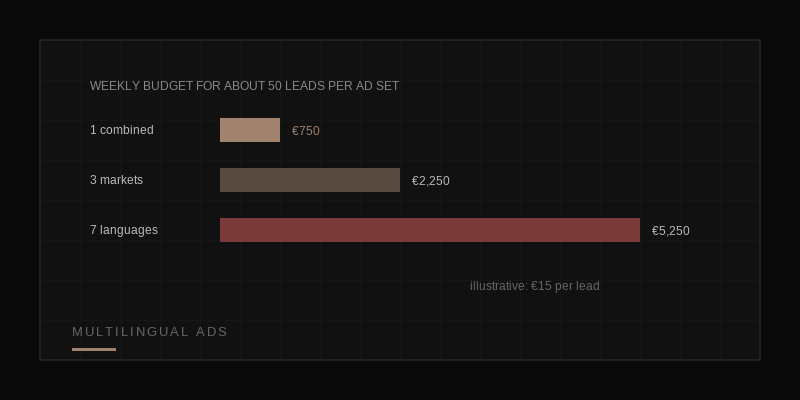
Meta's long-standing guideline is that an ad set needs roughly 50 optimisation events a week to leave the learning phase. Each time you split an ad set, you need more budget to reach that number in every part.
This example assumes a €15 cost per lead in every language. That figure is for illustration and is not a benchmark.
| Setup | Leads needed per week | Weekly budget at €15 per lead |
|---|---|---|
| One combined ad set | 50 | €750 |
| Three market groups | 150 | €2,250 |
| Seven language ad sets | 350 | €5,250 |
With €1,000 a week, seven ad sets would get about €143 each. At €15 per lead, that is around nine or ten leads per ad set, well short of 50. Use your own cost per lead in our learning phase budget guide before choosing a structure.
Three ways to set it up
1. One ad set per language
This gives you separate budgets, ads and reports. It works best when each language has enough budget and the offers are genuinely different. Check for overlap: if multilingual people qualify for more than one ad set, your own ads can end up competing for the same audience.
2. One multi-language ad
Meta's multi-language ads let you change parts of an ad, including its text, image or video, based on the viewer's language. This suits a smaller budget when the offer is the same everywhere.
According to Meta's Marketing API documentation:
- You must set exactly one default version. People see it when their language doesn't match any other version, which Meta says helps prevent under-delivery.
- Each setup uses either the single-image or single-video format.
- All placements are supported.
- The supported objectives include link clicks, conversions, reach and video views. Link click and conversion campaigns can't use Messenger as the destination.
These are the API rules. Ads Manager may use different names or options, so check what is available in your account. Choose the default language carefully too, because it is what everyone without a matching version will see.
3. Group by market, then adapt the language
This is often a good middle ground. Split markets where the business case differs, such as price, regulation, travel time or customer value, then use multi-language ads within each group. You get control where it matters without needing an ad set for every language.
Language and country aren't the same thing
German ads could reach people in Germany, Austria or Switzerland. Someone in Italy might use their phone in English. Language decides what people can comfortably read. Country can affect the rules, currency, travel options and delivery.
Review these two things separately:
- By language: ad copy, subtitles, text in images, landing pages, forms and replies
- By country: advertising rules, privacy requirements, prices, availability and travel details
A perfect translation can still break local advertising rules.
Keep the same language after the click
A translated ad makes a promise. If someone taps an Italian ad, lands on an English page and gets an English reply, that promise is broken. Check the whole journey:
- Ad: Are the text, subtitles and any words in the image in the same language?
- Landing page: Does the link open the right version, without making people find a language menu?
- Form or chat: Are the questions, error messages and privacy notice translated too?
- First reply: Can someone answer in that language, and how quickly?
- Follow-up: Are quotes, documents and instructions available in it?
Medical travel shows why this matters, because people need to understand detailed information before making a serious decision. One site built for several languages is MDTA, a medical and dental travel coordinator in Albania. Its language menu includes English, Italian, German, Polish, Spanish, Albanian and French. With separate language versions, an advertiser can send each audience straight to the right page.
A translated website only covers part of the journey. Before launching in any language, make sure your team can handle replies, documents and follow-up in it too. If not, say which languages you support before people get in touch.
Be careful with automatic translation
Meta's API can translate text from the default version into supported languages. Its documentation warns that edits to an automatic translation are overwritten if that language stays in the auto-translate settings. If someone corrects a translation, take that language out of auto-translate and add the corrected text as its own version.
For medical, financial or legal services, ask a fluent reviewer to check every version before launch. A small change can turn "may help" into a promise. Have them check the landing page and first reply as well as the ad.
What to track for each language
| Metric | What it can show |
|---|---|
| Click-through rate | Whether the ad connects with that audience |
| Landing page conversion rate | Whether the page matches the ad |
| Time to first reply in that language | Whether you have enough language support |
| Qualified lead rate | Whether you are reaching the right people |
| Cost per customer | Whether the market is worth more budget |
Use these as clues, not proof. If Polish ads get good click-through but few qualified leads, check the page and reply process before you blame the targeting. Save the customer's language and country as separate CRM fields so you can tell which one is affecting results.
Which setup should you choose?
- Small budget, same offer everywhere: start with one multi-language setup.
- Different prices, rules or customer value by country: group by market, then adapt the language.
- Enough budget and a different offer for each language: use separate ad sets.
- Can't reply in a language: don't launch in it yet.
Begin with the fewest ad sets that let you follow local rules and manage each market properly. Split further when you have enough results to justify it, not because you have another translation ready.
Disclosure: Thread Transfer has a personal connection to MDTA. We mention it as an example, not as medical advice or a recommendation. We checked its language options on 29 November 2026.
Learn more: How it works · Why bundles beat raw thread history