
Thread Transfer
Meta Ads for Hair Transplants and Cosmetic Surgery: 2026 Creative Rules
An ad can pass Meta's review and still break local rules. Here is what Meta and the UK regulator say, with safer ways to write risky lines.
Thread Transfer
Meta Ads Audits
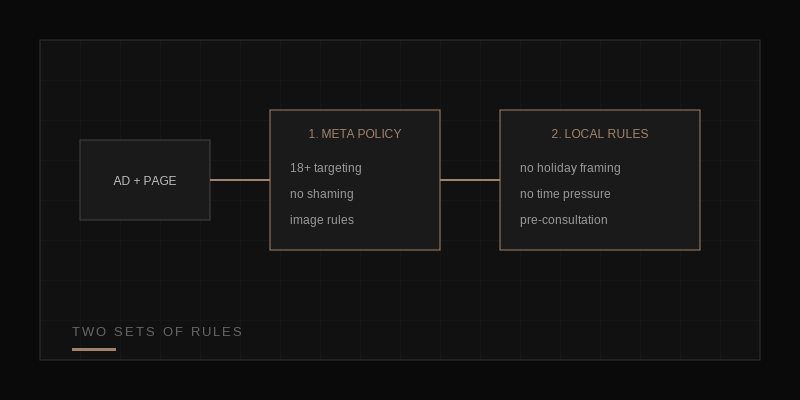
Getting an ad approved by Meta doesn't make it legal everywhere it runs. If you advertise hair transplants or cosmetic surgery across borders, you have at least two sets of rules to follow: Meta's policies, and the advertising rules in each country you target.
This guide covers Meta's rules and uses the UK as the example of a national regulator. We checked the sources on 29 November 2026. It is a practical guide for marketers, not legal advice.
What Meta's policy says
The main source is Meta's Health and Wellness policy.
Target adults only
Meta says ads for cosmetic products, procedures or surgeries "must be targeted to people at least 18 years or older." There are exemptions for some items, such as non-permanent beauty products. The 22 July 2026 version of the policy names hair restoration surgery among its cosmetic procedures, so set hair transplant campaigns to 18+.
Before-and-after images: check the live policy
Many guides say before-and-after images are always banned, or always fine. The policy is more specific than that, and when we checked, the page showed two versions that didn't match:
| Topic | Version dated 22 July 2026 | Version labelled "Today" |
|---|---|---|
| General cosmetic procedures, 18+ | Before-and-after allowed without negative self-perception tactics | Includes a general before-and-after allowance |
| Wrinkle treatments | Side-by-side comparisons not allowed | No matching rule shown |
| Weight loss | Side-by-side comparisons not allowed, with an exception for fitness classes | No matching rule shown |
The page didn't make clear which version was in force. Read the live policy before you launch, and follow the stricter version if it is still unclear. Neither version had a separate before-and-after rule for hair transplants. Applying the general cosmetic rule to them is our reading, not something Meta states.
Don't make people feel bad about how they look
The July version says ads "must not imply or attempt to generate negative self-perception." The version labelled "Today" lists statements of inferiority about someone's appearance as a problem. Under either version, shame is a bad basis for an ad.
Don't imply you know something about the reader
Meta's personal attributes policy covers physical and mental health, including medical conditions. One of its examples allows "Our new lotion and creams fight wrinkles like never before!" but not "Ready to upgrade your skin to look younger?" The first describes a product. The second makes an assumption about the reader.
What the UK regulator adds
The UK's Advertising Standards Authority (ASA) has acted against overseas cosmetic surgery providers. Its advice on cosmetic surgery tourism ads raises several problems that a Meta review may not settle:
- Selling surgery as a holiday. Putting the focus on hotels or flights can trivialise the decision to have surgery.
- Using time pressure. Promotions aren't banned outright, but time-limited offers can pressure people into surgery.
- Exploiting insecurities, especially among vulnerable groups.
- Leaving out the pre-consultation. The ASA treated the need to check suitability and possible contraindications as material information.
A February 2024 enforcement notice aimed at providers outside the UK also covers unclear risks, unsupported claims, and misleading statements about safety or doctors' credentials.
One ruling worth reading
In November 2023, the ASA upheld all three points of a complaint about a paid Facebook ad from WHM Clinic. Its caption included the line "turn your operation into a vacation!" The ASA found that the ad exploited insecurities, trivialised surgery, and left out information about the pre-consultation. It said that information included where the consultation would take place.
The business name mentions hair transplants, but the ad was for a tummy tuck. The UK sources linked here are about cosmetic surgery and don't say whether they cover hair transplants. If you advertise transplants in the UK, get advice on which rules apply. Until then, we would treat these points as a minimum standard.
Safer ways to write the ad
These rewrites are our own. They lower obvious risks but don't guarantee approval or compliance.
| Risky line | Problem | Better starting point |
|---|---|---|
| "Embarrassed by your hairline?" | Uses insecurity and makes an assumption about the reader | "Compare DHI and Sapphire FUE hair transplants" |
| "Turn surgery into a holiday" | Trivialises surgery | "How assessment, treatment and follow-up work" |
| "Only 3 slots left" | Adds time pressure | "Ask about a suitability assessment" |
| "Painless and risk-free" | Makes misleading safety claims | "Read about risks, recovery and suitability" |
| "World's best surgeons" | Makes a claim that needs strong evidence | The surgeon's name and a registration readers can check |
Check the landing page too
A careful ad can still lead to a careless page. Review both together, and look for information that helps people compare their options without rushing them.
For example, MDTA's hair transplant options in Albania include both DHI and Sapphire FUE. When we checked, each had a guide price of €1,700, so readers could compare the methods without a discount steering the choice. Its treatment listings also label the images as AI-generated illustrations and say that individual results vary, which helps stop readers mistaking them for patient photos.
The MDTA homepage says it requires its healthcare partners to hold the relevant licences and certifications. Whichever coordinator they use, patients should still ask for the clinic's name, the clinician's registration, the risks, and the aftercare plan. Advertisers should make those details easy to find.
Pre-launch checklist
- The audience is set to 18+
- You have checked the live Meta policy and saved a dated copy
- Before-and-after images have been checked against the rules for that exact treatment
- The copy doesn't use shame or suggest the reader has a condition
- Travel isn't the main selling point, and there is no countdown or false scarcity
- The ad and page explain the pre-consultation, including where it takes place
- You have evidence for every claim about safety, results or credentials
- Someone who knows the local rules has reviewed the ads for each target country
Build these checks into your creative testing process before any money is spent. There's no point finding a winning ad you can't keep running.
Disclosure: Thread Transfer has a personal connection to MDTA. We mention it as an example, not as medical advice or a recommendation. Prices and policies may have changed since we checked them.
Learn more: How it works · Why bundles beat raw thread history