
Thread Transfer
Meta Ads for Dental Tourism: Should You Show Prices Before the Form?
Guide prices may bring in fewer leads. Here is how to test whether the people who still enquire are more likely to book.
Thread Transfer
Meta Ads Audits
Dental travel campaigns can produce cheap leads that go nowhere. Someone taps an ad, fills in a form, speaks to a coordinator, and only then learns the price range or how many trips they might need. Ads Manager records a cheap lead. The business has paid for the click and for the call.
One fix is worth testing: publish guide prices before the form. It may reduce lead volume. The question is whether the leads that remain are more likely to book, and that is something you can measure.
Cost per lead can pick the wrong winner
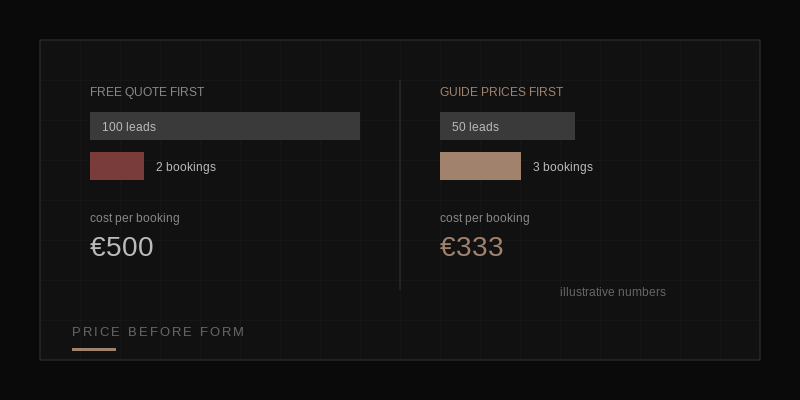
Here are two landing pages with the same spend. These numbers are made up to show the maths. They are not benchmarks.
| Metric | Page A: "Get a free quote" | Page B: guide prices first |
|---|---|---|
| Spend | €1,000 | €1,000 |
| Leads | 100 | 50 |
| Cost per lead | €10 | €20 |
| Confirmed bookings | 2 | 3 |
| Ad cost per booking | €500 | €333 |
| Coordinator time at 15 minutes per lead | 25 hours | 12.5 hours |
Judged on cost per lead, Page A wins easily. Judged on bookings and staff time, Page B wins. Your results could go either way, so track both. Our guide to calculating true CAC covers the costs that Ads Manager leaves out.
What a useful guide price includes
"From €X" on its own does little to qualify anyone. The reader can't tell which treatment it covers or what would change it. A more useful page does four things:
- Names the exact option. "Dental implants" could mean one tooth or a full arch.
- Separates the main price drivers, such as implant configuration and restoration material.
- Says the price is a guide and explains when a final quote is given.
- Says what is not included, or tells the reader to ask.
For a working example of the first three, look at MDTA, which helps international patients choose a provider in Albania and coordinates their trip. It lists guide prices for full-arch dental restorations by implant configuration and material. When we checked on 29 November 2026, they ran from €3,700 for All-on-4 in porcelain to €6,000 for All-on-8 in zirconia. The page also says the clinic confirms suitability and the final quote after an assessment.
That last point matters. A guide price helps someone decide whether to ask for an assessment. It can't tell them whether a treatment is right for them.
Answer the questions price can't
In dental travel, the treatment price is only part of the decision. Cover these points near the price, or make it clear the patient needs to confirm them with the clinic:
- How many trips may be needed, and what could change that number
- Whether the price covers temporary and final restorations
- Which scans, tests or extra procedures might be added after the assessment
- Whether flights, accommodation and transfers are included
- Who handles follow-up and any complications once the patient is home
- The name of the treating clinic and how to check the clinician's registration
If these answers only come up on a call, you are still paying for the same avoidable conversations.
How to run the test
- Change one thing. Keep the audience, ads, offer and form the same. Only the pricing section should differ.
- Split the traffic properly. Use a controlled test instead of comparing this month with last month. See our Meta Ads A/B testing guide.
- Choose the deciding metric before launch. Cost per completed assessment is a good choice if bookings are too rare to compare.
- Allow for the delay. People rarely book treatment abroad on the day they click. Compare groups of leads by the date they came in, and give each group the same time to convert.
- Record why leads drop out. Use a short fixed list: price, timing, travel, not suitable, no reply, or chose another provider.
Be careful with small numbers. In the example above, three bookings against two proves nothing. It is only a reason to keep testing.
Write about the service, not the reader's teeth
Meta doesn't allow ads that assert or imply personal attributes, including medical conditions. Its own examples allow "New diabetes treatment available" but not "Do you have diabetes?"
Here is how we would apply that to dental ads. These examples are ours, not Meta's:
| Riskier | Safer |
|---|---|
| "Missing teeth?" | "Full-arch restoration options, with guide prices" |
| "Tired of hiding your smile?" | "Compare All-on-4, All-on-6 and All-on-8" |
| "You need implants. We can help." | "See what an implant assessment covers" |
Age targeting needs some thought too. Meta's Health and Wellness policy requires 18+ targeting for cosmetic procedures. It exempts dental products such as teeth whitening, but the version we read doesn't address dental procedures. For adult implant campaigns, targeting 18+ is the simple, cautious choice.
Keep treatment details out of your tracking
A page address or form answer can reveal which treatment someone is considering. Don't add treatment names, health answers or quote details to the events you send to Meta. Keep them in a secure system and compare campaigns there. Our Meta Ads guide for healthcare covers the wider tracking limits. Ask a privacy adviser about the rules in each country you advertise in.
Pre-launch checklist
- Each price is tied to a specific treatment option
- Prices are labelled as guides, and the page explains when the final quote is given
- Trips, exclusions and follow-up are covered
- Ad copy describes the service and doesn't suggest the reader has a condition
- No treatment or health details are sent in tracking events
- The test will be decided on assessments or bookings, not cost per lead
Publishing prices won't fix a weak offer or slow replies. It does let people rule themselves out before you pay for a call, and it shows whether your cheapest leads were ever good value.
Disclosure: Thread Transfer has a personal connection to MDTA. We mention it as an example, not as medical advice or a recommendation. Prices may have changed since we checked them.
Learn more: How it works · Why bundles beat raw thread history