
Thread Transfer
Click-to-WhatsApp Ads: How to Measure Lead Quality After the Chat Starts
The campaign with the cheapest chats may have the most expensive customers. Here is how to measure what happens next, with extra care for health data.
Thread Transfer
Meta Ads Audits
Click-to-WhatsApp ads make it easy for someone to start a conversation. They also make it easy to overrate a campaign. A person who sends "hi" and disappears counts as a conversation, and so does someone who books.
To find out which ads bring in customers, you need to track what happens after the chat starts. This guide covers a simple CRM method and Meta's more technical option. It also explains why health-related businesses need to be especially careful about what they share.
Cheap chats can be expensive customers
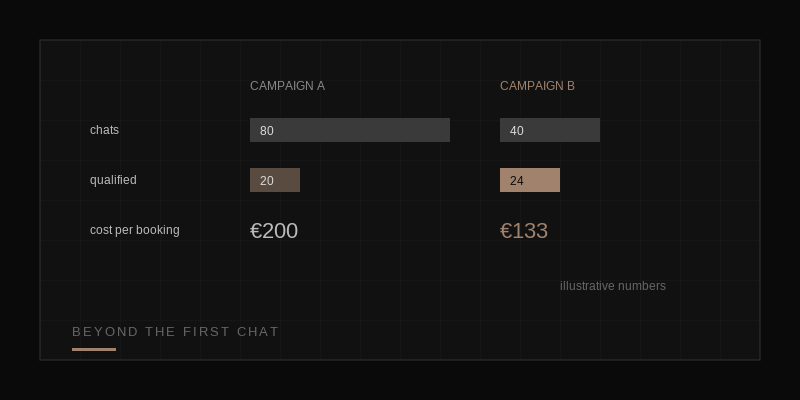
Compare two campaigns with the same spend. These numbers are made up to show the maths. They are not benchmarks.
| Metric | Campaign A | Campaign B |
|---|---|---|
| Spend | €800 | €800 |
| Conversations | 80 | 40 |
| Cost per conversation | €10 | €20 |
| Qualified leads | 20 | 24 |
| Cost per qualified lead | €40 | €33 |
| Bookings | 4 | 6 |
| Cost per booking | €200 | €133 |
If you only look at conversations, you would put more money into Campaign A. Campaign B brought in more qualified leads and more bookings, with half as many chats to answer. These numbers are too small to prove which campaign is better, but they show why you need to look past the first message.
Agree what each stage means
Reports won't help if each person on your team has a different idea of a "qualified" lead. Write down a clear rule for every stage:
| Stage | Example rule |
|---|---|
| Conversation | The person sends a first message |
| Engaged | They reply after your first response |
| Qualified | They want a service you offer, in a place you serve, within a realistic timeframe |
| Next step booked | They agree a date for a call, visit or assessment |
| Customer | They confirm the booking under your normal process |
For a health service, "qualified" should only describe whether the enquiry is a practical fit. It must never mean someone is medically suitable for treatment. That decision belongs to a qualified clinician.
Option 1: add a reference code
You don't need an API integration to get started. Give each campaign a short, neutral code and add it to the pre-filled WhatsApp message:
Hi, I'd like some more information. Ref: A12
When a chat arrives, save the code in your CRM and update the stage as the conversation moves forward. Each week, compare the stage totals with what you spent on each code.
- Keep codes neutral. Use "A12", not the name of a treatment, condition or audience.
- Expect some gaps. People can edit or delete the code before sending. Record those chats as "unknown" and don't guess.
- Don't reuse codes. Otherwise, old chats can be counted towards a new campaign.
- Save only what you need. A code and stage are usually enough to compare campaigns. You don't need to copy the whole chat.
This method also suits businesses that choose not to track website visitors. For example, MDTA's medical and dental travel website offers WhatsApp as a contact option and says it sets no cookies or tracking. A business with that kind of setup can't rely on website tracking to judge an ad. It can use the ad platform's own totals and, with suitable privacy safeguards, the stages its team records. We are using MDTA as an example of a website setup. We don't know how it measures its advertising.
Option 2: send chat results back to Meta
Meta also offers a Conversions API for business messaging. It can link a later result to the click that started the chat:
- Someone starts a chat from a click-to-WhatsApp ad.
- The Messages webhook includes a click ID, called
ctwa_clid, in itsreferraldata. - You store that ID with the conversation.
- When a tracked result happens in the chat, you send Meta an event with the same ID.
Meta's list of business messaging events includes LeadSubmitted, QualifiedLead and Purchase. Before you build anything, note these points from its documentation:
- Only send events that happen in the chat. If the result happens on your website or app, use the web or app Conversions API.
- Remove duplicates yourself. Meta says it doesn't help deduplicate these events.
- Plan your dataset. You can only link one dataset to a page.
- Check that you keep the click ID. If you use a messaging provider, confirm that its webhook passes
ctwa_clidto you.
If you are new to server-side events, start with our guide to the Conversions API.
Health businesses: get privacy advice first
Meta describes ctwa_clid as a personal identifier. If you link it to a clinic, a treatment chat or a "qualified" stage, it could reveal something about a person's health, even if you never send the chat itself.
Under GDPR, data about health is a special category of personal data with extra protection. The Meta page we read explains how to send events but doesn't cover health data. Just because the API accepts an event doesn't mean you are allowed to send it.
Before sending chat events for a health-related service, ask a privacy professional to review the data, legal basis, consent and contracts. Until that is done:
- Don't send chat stages to Meta
- Keep treatment names and health details out of codes, campaign names and event data
- Limit who can see chats, and set a date for deleting them
- Compare campaigns using totals, not individual people
Reference codes need care too. A code saved beside a named person's health enquiry is part of that person's record, so include your CRM in the review. Our healthcare advertising guide covers more of the tracking limits.
Check your replies before blaming the ad
Poor results can come from slow or confusing replies as well as poor targeting. Compare these numbers for each campaign:
- Time to first reply, split between working hours and out of hours
- Engaged rate: engaged chats divided by all conversations
- Qualified rate: qualified leads divided by engaged chats
- Next-step rate: booked next steps divided by qualified leads
- Unknown source rate: chats without a code divided by all conversations
If people stop responding after your first message, check how quickly you replied and what you said. If they engage but few are a fit, look at the ad's promise and audience. If lots of chats have no code, fix the tracking before you move any budget.
A four-week plan
- Week 1: agree the stages, add neutral codes and review how you handle data.
- Week 2: check a sample of chats to make sure everyone uses the stages in the same way.
- Week 3: fix slow replies and missing codes. Avoid changing the ads at the same time.
- Week 4: compare cost per qualified lead, and give newer leads time to book before judging cost per booking.
If you have too few bookings to compare, use cost per qualified lead for now and keep collecting data. Our guide to lowering CPA while increasing leads covers what to do next. A conversation only tells you that someone opened the door. Put your budget behind the campaigns that lead to real customers.
Disclosure: Thread Transfer has a personal connection to MDTA. We mention it as an example, not as medical advice or a recommendation. We checked its website on 29 November 2026.
Learn more: How it works · Why bundles beat raw thread history